How Is a Bronze Sculpture Made? The Lost-Wax Casting Technique
Behind every bronze sculpture lies a far more complex process than the finished artwork might suggest. Before reaching its final form, a sculpture goes through numerous stages: modelling, mould-making, wax casting, bronze pouring, chasing and finally patination.
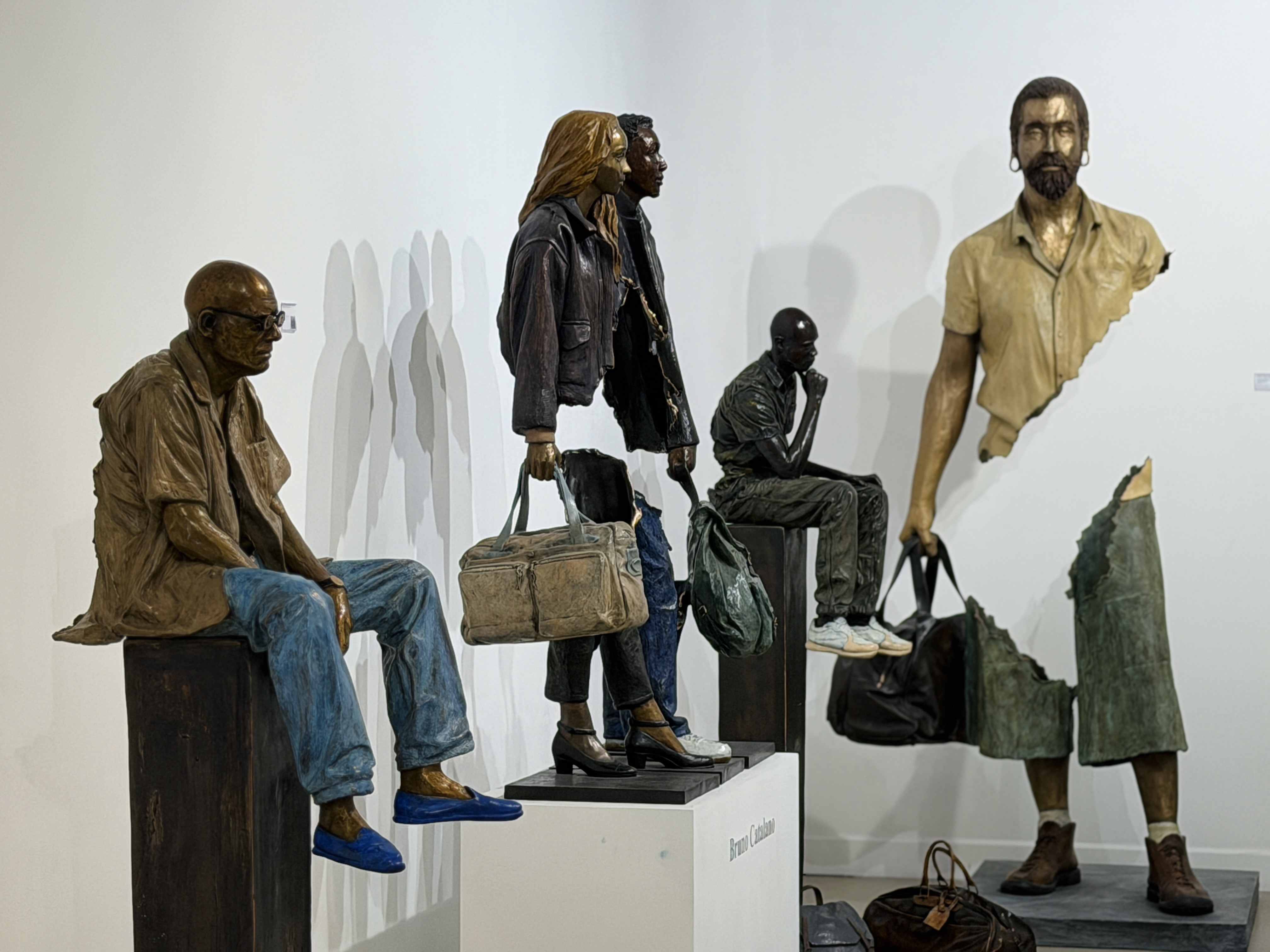
Among the techniques used by sculptors and art foundries, lost-wax casting holds a particularly important place. Used since antiquity and still widely practised today, it allows artists and craftsmen to reproduce volumes, textures and fine details with remarkable precision. The technique is still used for many contemporary bronze sculptures, including works by Bruno Catalano, one of the emblematic artists represented by Galerie De Medicis for more than twenty years.
But how does a sculpture actually move from the artist’s original model to a finished bronze artwork?
It all begins with the sculptor’s model
Long before the bronze is poured, the sculpture begins in the artist’s hands.
The sculptor first creates a model using a material that allows volumes, proportions, posture and expression to be developed and modified. Clay is frequently used during this initial stage because of its flexibility and responsiveness. For Bruno Catalano, this relationship with modelling is fundamental. The artist began working with clay in the early 1990s before progressively learning the techniques required to translate his sculptures into bronze. His practice perfectly illustrates the dialogue between the sculptor’s original gesture and the highly precise craftsmanship of the foundry. The model therefore forms the starting point of the artwork: it already contains the posture, proportions and expression that will ultimately appear in the finished bronze sculpture.
Creating the mould: preserving the sculpture’s form
Once the original model is complete, a mould is produced in order to reproduce every detail of the sculpture as faithfully as possible. In the indirect lost-wax casting process, this mould allows the original model to be preserved while producing a replica in wax. This step is particularly important when a sculpture is intended to exist in several examples as part of a limited edition. The mould must reproduce not only the overall volumes of the artwork but also its most subtle details: the folds of clothing, facial features, surface textures and traces of the artist’s modelling. This ability to preserve intricate details is one of the reasons lost-wax casting remains such an important technique in sculpture.
Producing the wax model
The mould is then used to create a new version of the sculpture, this time in wax. This is the stage that gives the lost-wax technique its name. The wax reproduces the form of the original artwork and can still be carefully refined before the casting process begins. Imperfections can be corrected, details adjusted and the surface carefully checked. The wax model should therefore not be considered merely as an industrial intermediate stage. It is an essential part of the artistic production process. For complex works such as Bruno Catalano’s Les Voyageurs, characterised by fragmented bodies, dramatic openings and seemingly impossible balances, this level of precision becomes particularly important.
Why is it called “lost-wax” casting?
A system of wax channels is attached to the wax model. These channels will later allow the molten bronze to circulate through the mould while gases and air escape. The entire structure is then surrounded by a heat-resistant investment material capable of withstanding the extremely high temperatures required for bronze casting. When the mould is heated, the wax melts and drains away. What remains inside is an empty cavity reproducing the exact shape of the original sculpture. This disappearance of the wax explains the name “lost-wax casting.” The molten bronze can then occupy precisely the space previously filled by the wax.
Casting: when bronze replaces the wax
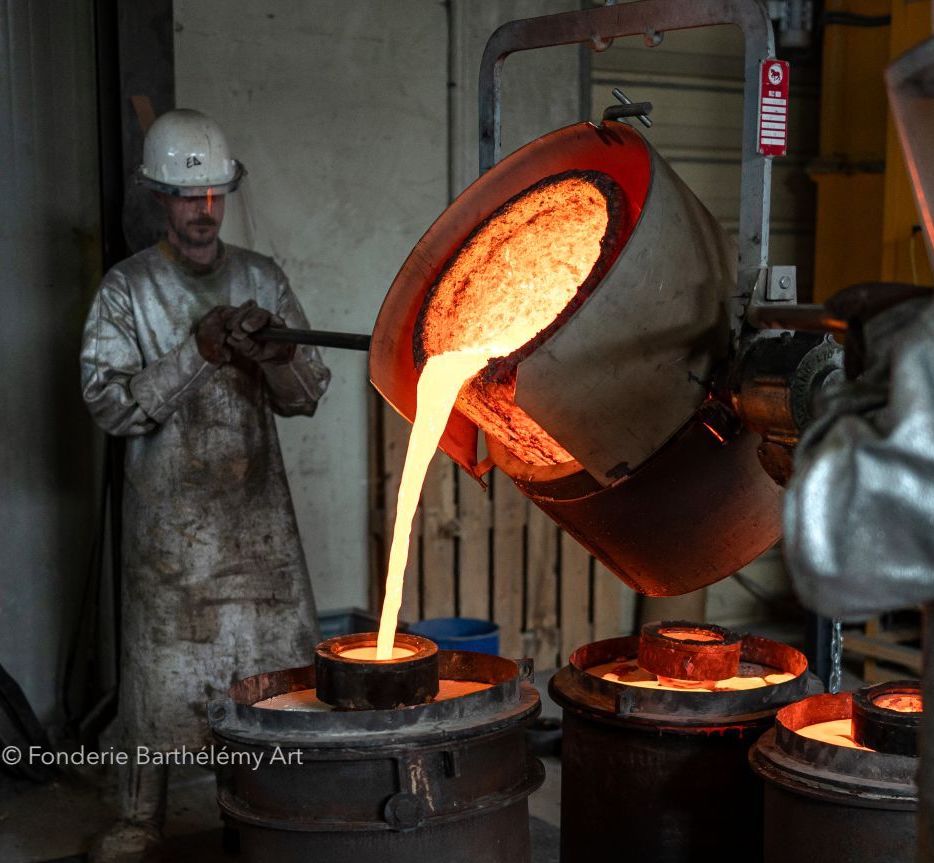
Next comes one of the most spectacular stages of the process: pouring the molten bronze.
The metal is heated to an extremely high temperature before being poured into the mould. It flows through the channels and gradually fills the cavity left behind by the wax. Once the bronze has cooled and solidified, the outer mould is broken away to reveal the metal sculpture. For the first time, the artwork appears in the material in which it will ultimately be presented. Large or particularly complex sculptures may be cast in several separate sections before being assembled. Creating a bronze sculpture therefore requires a constant dialogue between artistic intention and technical expertise.
Chasing and finishing: removing the traces of the casting process
Removing the sculpture from its mould does not mean that the artwork is finished. The channels used to circulate the bronze must first be removed. Separate sections may then need to be welded together before the surface undergoes an extremely detailed process known as chasing. During this stage, the bronze is carefully reworked to recover the precision of the original model and eliminate visible traces of the casting process. When the work is complete, the viewer should no longer perceive the numerous technical operations required to create the finished sculpture. It is here that the craftsmanship of the foundry becomes almost invisible.
Patination: giving bronze its colour
The final major stage is patination.
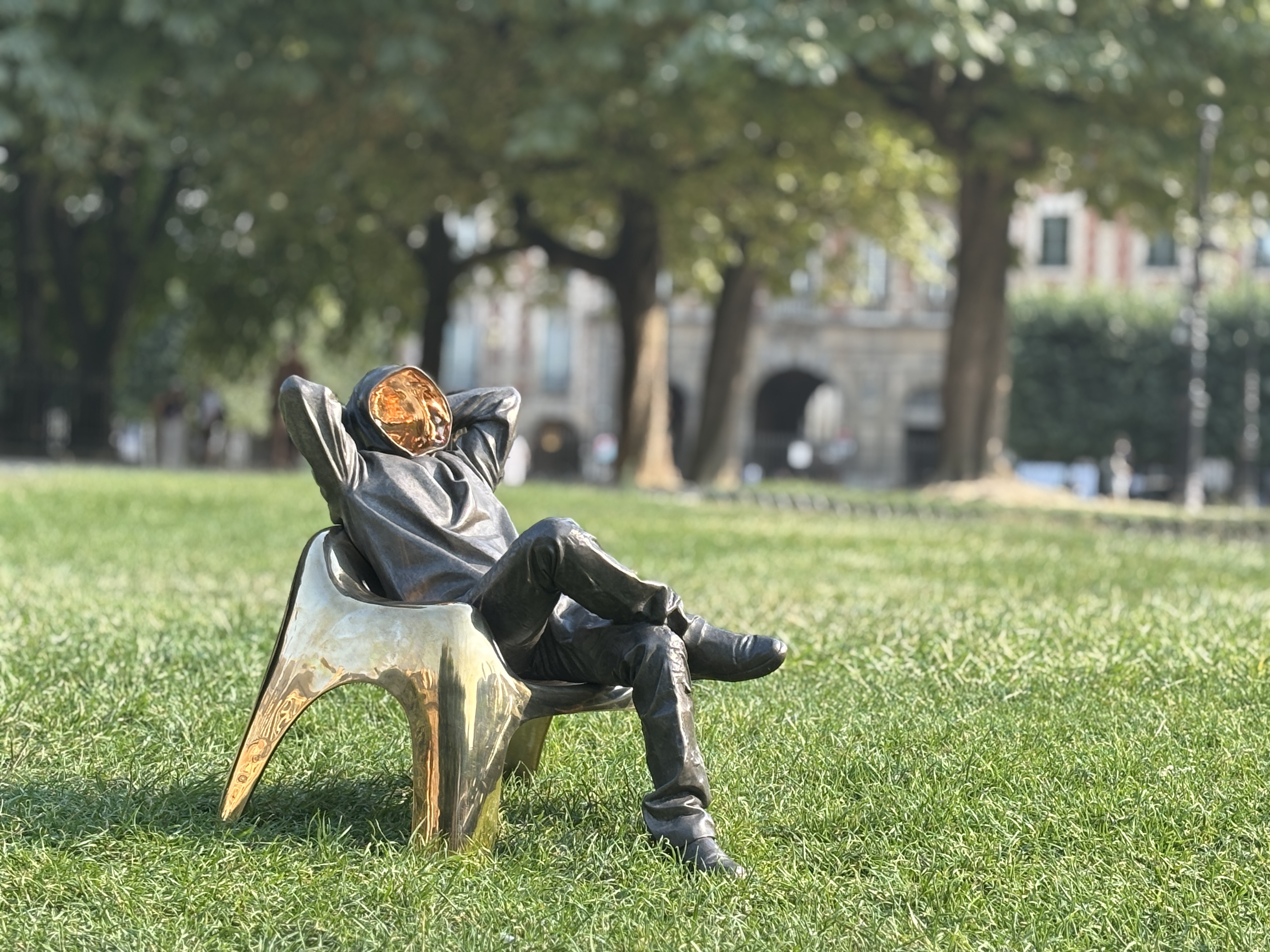
Contrary to what one might imagine, the colour of a bronze sculpture is not necessarily the natural colour of the raw metal. Different chemical products are applied to the surface of the bronze, often with heat, in order to produce controlled oxidation. Depending on the desired result and the work of the patina specialist, bronze can take on shades ranging from deep brown and black to green, blue or much brighter tones. Patination therefore plays an essential role in the visual identity of a sculpture. The same model can create very different impressions depending on the depth, contrast and colour variations chosen by the artist. This aspect is particularly visible in the works of Bruno Catalano, where clothing, faces, luggage and other elements of the Voyageurs are often animated by a rich variety of colours and textures.
For Bruno Catalano, working in bronze is closely connected to the evolution of his artistic language. After beginning with clay modelling, the artist learned lost-wax bronze casting in the early 2000s, allowing him to translate his sculptures into bronze. A few years later, a technical event would play an important role in the development of his work. In 2004, during a casting process, part of one of his sculptures was accidentally lost. Instead of seeing this absence simply as a defect that needed to be repaired, Catalano became interested in the void it created within the human body.
From it emerged the fragmented silhouettes that have since become inseparable from his work: Les Voyageurs. Parts of the body appear to have disappeared, yet the figure continues to stand, often connected through a suitcase that becomes both a structural element and a symbol of travel, memory and displacement. Bronze, traditionally associated with weight, permanence and solidity, is therefore confronted with emptiness. This tension between solidity and absence, matter and space, presence and disappearance is one of the most distinctive characteristics of Bruno Catalano’s sculptures.

From Bruno Catalano to Dominique Rayou: bronze sculpture at Galerie De Medicis
Bronze sculpture occupies an important place within the selection presented by Galerie De Medicis on Place des Vosges in Paris.
Alongside Bruno Catalano’s Voyageurs, the gallery also presents works by Dominique Rayou, including numbered bronze sculptures produced using the lost-wax process. Bronze can also be found in the work of Arman, a major figure of Nouveau Réalisme, whose sculptures offer a radically different approach to the same material. The same medium can therefore produce profoundly different artistic languages: bodies crossed by emptiness in Bruno Catalano’s work, organic and fragmented forms in Dominique Rayou’s sculptures, and the transformation or accumulation of everyday objects in the work of Arman.