Bruno Catalano’s Les Voyageurs: Meaning and Symbols
Les Voyageurs by Bruno Catalano have become one of the most recognizable series in contemporary bronze sculpture. With their fragmented bodies, moving silhouettes and luggage, these figures explore themes of travel, exile, memory and identity.
Now considered the visual signature of the artist, the sculptures from Les Voyageurs immediately stand out through the void that crosses their bodies. Far from making the figures feel incomplete, this absence becomes the very source of their symbolic power.
Who are Bruno Catalano’s Les Voyageurs?
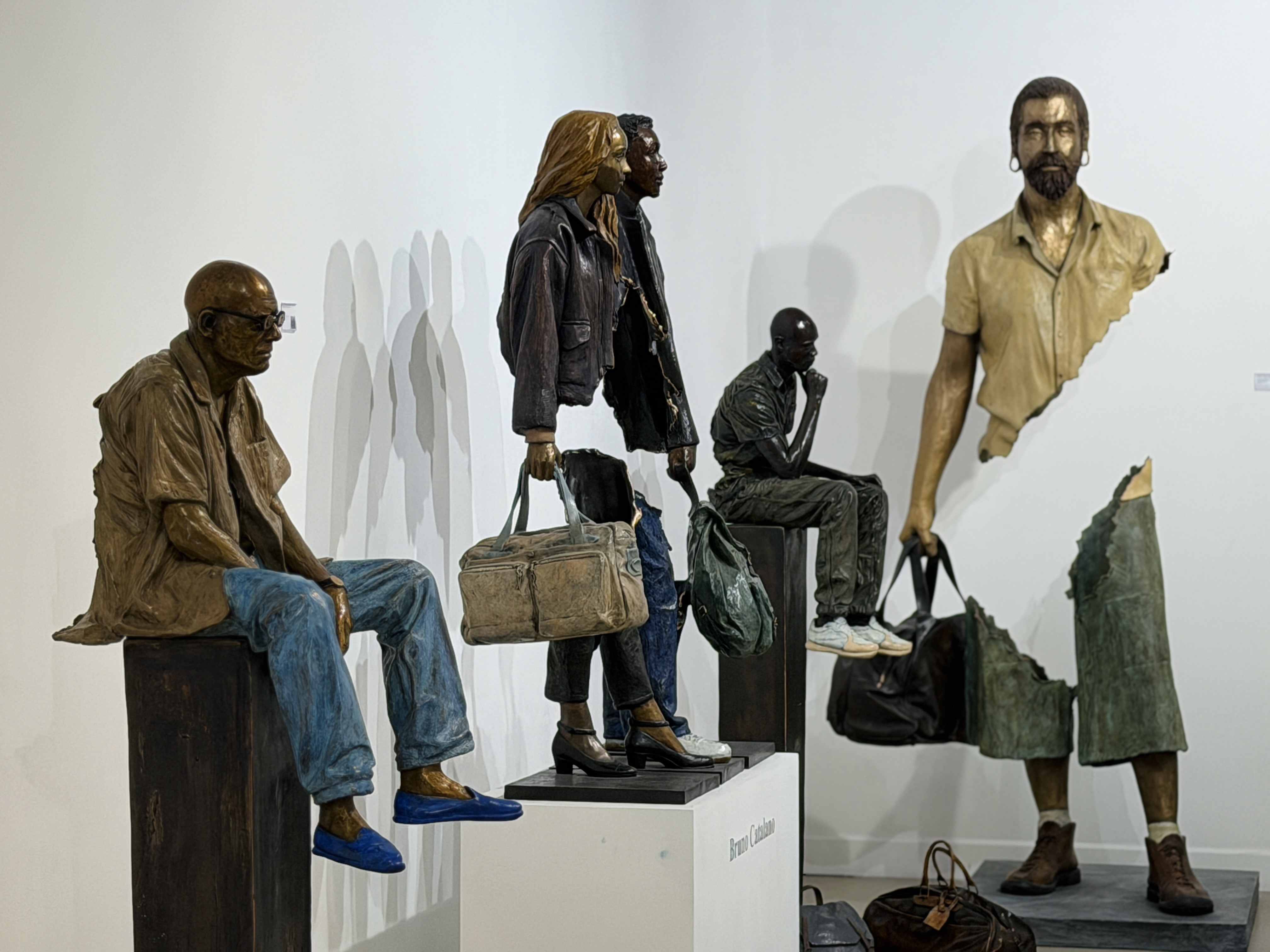
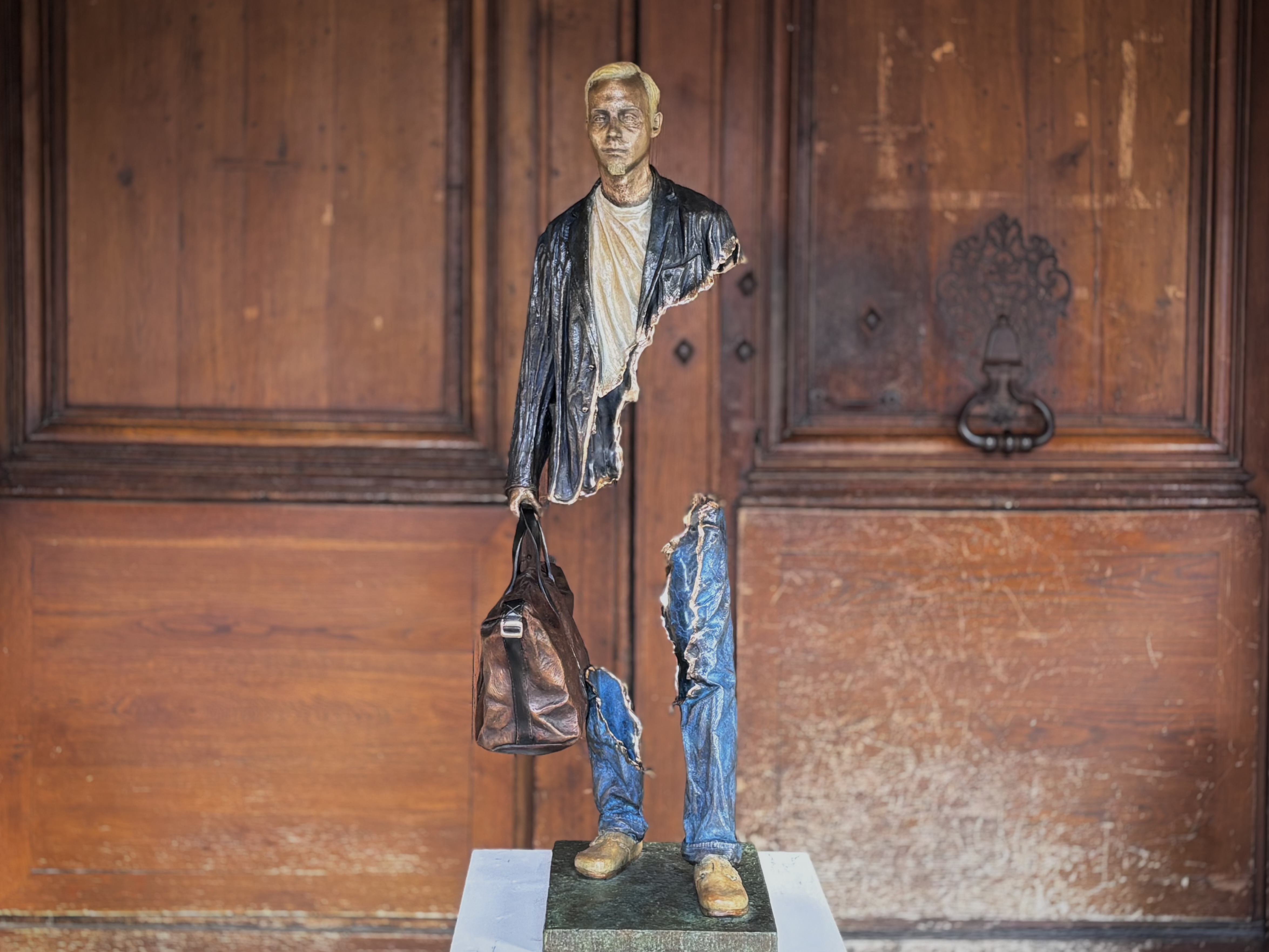
Les Voyageurs is a series of figurative bronze sculptures depicting men and women in motion. Some are walking, others seem to pause or wait, but almost all are accompanied by a suitcase, bag or piece of luggage. Their most distinctive feature is the dramatic fragmentation of the body: a large part of the figure disappears between the torso and the legs, while a limited number of contact points allow the sculpture to remain perfectly balanced. Created in a wide range of sizes, from more intimate formats to monumental works, Bruno Catalano’s figures have been exhibited both in galleries and in public spaces in France and internationally. Over the years, Les Voyageurs have become inseparable from the name of Bruno Catalano and from his unique artistic language.
What does the fragmented body in Les Voyageurs mean?
At the heart of Bruno Catalano’s work lies the radical choice of the fragmented body. The central part of the figure is deliberately absent, creating a void that becomes an essential component of the sculpture itself. This rupture can evoke everything that travel may leave behind: a place, a person, a language, memories or even a part of oneself. The contrast is particularly striking because the sculptures are made of bronze. Traditionally associated with strength and permanence, the material here gives life to figures that appear fragile and incomplete. And yet, the Voyageurs remain standing.
This tension between presence and absence, strength and fragility, matter and emptiness is one of the most powerful elements in Bruno Catalano’s work. The viewer is naturally invited to imagine what is missing and mentally reconstruct the figure. Each sculpture therefore becomes a fragment of a story, open to interpretation through each viewer’s own experience.
The suitcase: a key symbol in Bruno Catalano’s work
The suitcase is another emblematic element in Les Voyageurs. A bag, briefcase or suitcase often creates the final physical connection between the different parts of the fragmented body. But its meaning goes far beyond the technical construction of the sculpture. The suitcase represents everything we choose to carry with us: memories, attachments, identity, experiences, hopes and wounds. In Bruno Catalano’s artistic universe, travel is therefore never purely geographical. It can evoke exile and migration, but also the more intimate transformations that shape a life: leaving a place behind, moving to another country, building a new identity or simply continuing forward. The luggage becomes a material expression of what remains with us when everything else seems to have changed.
Travel, exile and identity in Bruno Catalano’s sculptures
Bruno Catalano’s personal history is deeply connected to ideas of movement, departure and uprooting. Through Les Voyageurs, the artist explores an identity that is never entirely fixed. Every departure transforms the person who travels: something is lost, while something else is created. His figures are therefore not simply travellers in the physical sense. They embody a humanity in constant motion, shaped by departures, encounters, separations and transformations. This is also what gives the sculptures their universal dimension. Faced with a Voyageur, each viewer can recognize a part of their own story: a departure, a change of life, an absence, a feeling of displacement or a new beginning.
Why do Bruno Catalano’s Les Voyageurs appeal to collectors?
The lasting success of Bruno Catalano’s sculptures among collectors is closely linked to their ability to combine an immediately recognizable visual identity with a strong narrative dimension. The open silhouette, movement, bronze, luggage and void create an artistic vocabulary that can be identified at first glance. Yet every sculpture retains its own personality. The posture, figure, clothing, patina, suitcase and scale of the work all significantly influence the way each piece is perceived. This combination of contemporary figurative sculpture and reflection on identity allows Bruno Catalano’s work to integrate naturally into both contemporary collections and more classical environments. The wide range of available formats also makes it possible to display Les Voyageurs in very different settings, from private interiors to gardens or larger architectural projects.
Bruno Catalano sculptures in Paris
Located on Place des Vosges in Paris, Galerie De Medicis presents a selection of Bruno Catalano sculptures available for acquisition, including several works from the celebrated Les Voyageurs series. Seeing these sculptures in person allows visitors to fully appreciate their complexity. Depending on the viewing angle, the void interacts differently with the silhouette, integrating the surrounding space, architecture and landscape into the composition. The richness of the patinas, the bronze craftsmanship, the textures of the clothing and the realism of the luggage are also revealed with a level of precision that photography alone cannot fully convey. At Galerie De Medicis, we assist collectors in choosing a Bruno Catalano sculpture according to the desired size, composition, patina and the space in which the artwork will be displayed.
Each Voyageur therefore becomes a meeting point between the story imagined by the artist and the personal history of its future collector.
Discover Bruno Catalano sculptures available at Galerie De Medicis →