
Art & Tax Benefits
For companies and professionals wishing to acquire or lease an artwork. The applicable tax treatment may vary depending on the company’s status, tax regime, jurisdiction and chosen financing solution.
Art leasing can offer several financial and tax advantages for a company. This solution makes it possible to spread the cost of the acquisition over several months without immediately committing the full amount of available cash.
From a tax perspective, lease payments may be treated as deductible business expenses, provided that they meet the applicable tax requirements and are incurred in the interests of the company’s business activity.
Leasing can be an attractive solution for acquiring artworks through staggered payments, with accounting and tax implications that may vary depending on the company’s specific circumstances.
Choice of the work and signature of the lease agreement
Lease payments and tax optimisation
End of lease: purchase option or other financial choice
The operation
- You lease the work for a period of 12 to 48 months.
- Lease payments may be deducted from taxable profits when they qualify as business expenses incurred in the interests of the company and meet the applicable tax requirements.
- The work is displayed on the company's premises.
- VAT charged on lease payments may be recoverable where the company is entitled to deduct VAT under the applicable rules.
- Leasing provides companies with greater financial flexibility by spreading the cost of the operation over time while potentially allowing lease payments to be treated as deductible expenses, depending on the company’s tax situation.
- After the lease period, the artworks may be transferred to a third party through a purchase option. Under certain conditions, leasing may allow an employee, shareholder, or company director to acquire the artwork at the end of the contract, in accordance with the agreed terms.
The advantages
- Tax treatment: Depending on the company’s circumstances and the applicable tax regime, monthly lease payments may, under certain conditions, be treated as deductible expenses.
- VAT recovery: VAT may be recoverable where the company is entitled to deduct VAT.
- Spread of expenses: May help preserve the company’s cash flow by spreading the cost of the acquisition over time.
- Building a collection at lower cost: At the end of the contract, a purchase option may be offered in accordance with the terms agreed with the financing partner and the residual value specified in the contract.
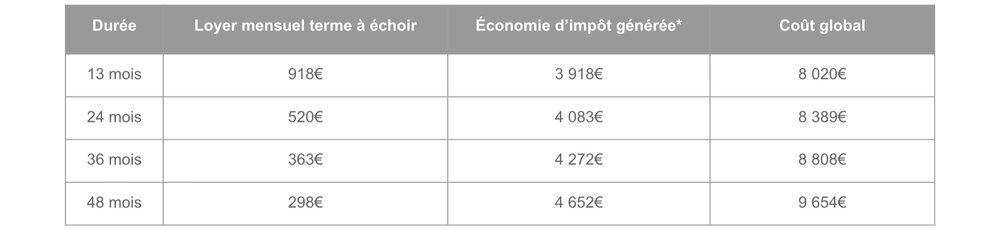
Example for an acquisition amount: €10,000, estimated tax rate 31%.
How to set it up?
As soon as you have selected your work at the gallery, our team steps in to offer you the most attractive solution.
De Medicis Gallery works with specialised leasing partners to assist companies wishing to finance the acquisition of an artwork.
Once the artwork has been selected, the financing partner purchases it from the gallery and makes it available to the company under the lease agreement. The lessor remains the owner of the artwork throughout the lease period. Depending on the terms of the agreement, a purchase option may be available at the end of the contract.
It is always the lessor who offers the company or a third-party beneficiary the buyback of the work at its residual value.
Tax deduction for the acquisition of works by living artists
In France, companies acquiring an original work by a living artist may, subject to certain conditions, benefit from a specific tax deduction under Article 238 bis AB of the French General Tax Code. The scheme currently applies to qualifying acquisitions made before 31 December 2028.
Eligible companies are:
- Companies subject to French corporate income tax, whether automatically or by election
- Certain companies taxed under the industrial and commercial profits regime (BIC).
- The acquisition price may be deducted from taxable profits over the year of acquisition and the following four years in equal instalments, corresponding to 20% of the acquisition price per year. The annual deduction is subject to a limit of €20,000 or 0.55 ‰ of turnover, where the latter amount is higher, reduced where applicable by qualifying corporate sponsorship payments.
- The deduction is applied separately when determining the company’s taxable profit.
Transfer:
- If the artwork is sold, its use is changed or an amount is withdrawn from the special reserve account, the deductions previously claimed may be added back to the company’s taxable profit in accordance with Article 238 bis AB of the French General Tax Code.
- If use of the works changes or they are transferred, during or after the five-year deductible benefit period, the deduction amount received by the company is reintegrated into taxable income.
Conditions to qualify:
- The work must be produced by an artist residing in France or abroad.
- The artwork must be displayed free of charge in a location accessible to the public or to the company’s employees, excluding their individual offices, throughout the year of acquisition and the following four years. Appropriate information should also be provided regarding the existence and location of the displayed artwork.